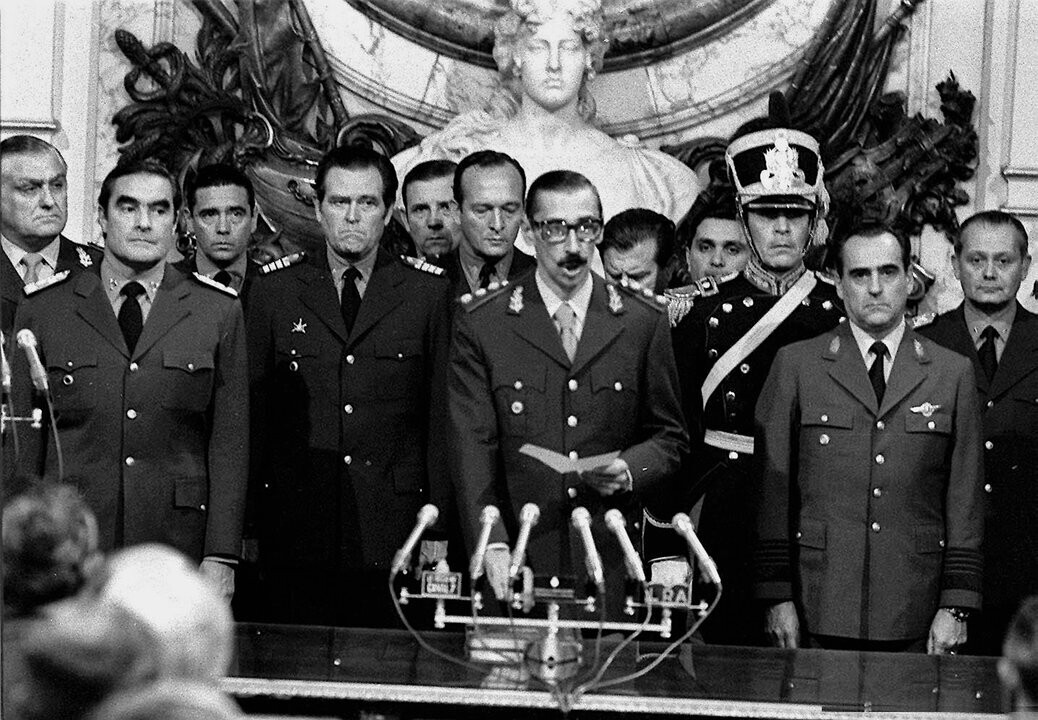
Buenos Aires, March 22 (NA) — This Tuesday, March 24, marks the 50th anniversary of the 1976 coup d'état in Argentina, initiated by the three armed forces, commanded by Jorge Rafael Videla (Army), Emilio Massera (Navy), and Orlando Agosti (Air Force), after overthrowing then Vice President in charge of the Executive Branch, Estela Martínez, widow of Juan Domingo Perón. The so-called 'National Reorganization Process' began what was later, in the Trial of the Military Juntas, termed state terrorism, establishing a regime based on kidnapping, torture, and forced disappearance of people, with the operation of clandestine detention centers such as the Navy Mechanics School (ESMA), one of the most significant sites during this period. The widespread repression affected political, union, and social activists alike, with the aim of disciplining society and restructuring the economy. Congress was dissolved and freedom of expression was eliminated. The months prior to March 24, 1976, were marked by a weak constitutional order, an unprecedented economic crisis, and a significant escalation of political violence throughout the territory. This situation directly impacted inflation, which soared to 182% annually, while real wages plummeted. The 'Rodrigazo,' as it became popularly known, led the CGT to initiate the first general strike against a Peronist government. The scenario was one of the worst in Argentine history: the country faced an unimaginable fiscal deficit, an exorbitant fall in reserves, and growing social discontent that fueled the climate of instability preceding the coup. Due to this, the three armed forces coordinated their actions from mid-year to take full control of the country uniformly (unlike the previous five coups). The Latin American context was no different: it was traversed by the consolidation of dictatorships aligned with the United States' National Security Doctrine, aimed at 'combating communism.' This 'fight' was carried out through the systematic implementation of Operation Condor, a network of transnational repressive coordination created in November 1975 by all the dictatorships of the Southern Cone to pursue, kidnap, torture, and assassinate political opponents from the entire region. For this reason, official figures from complaints documented by the National Commission on the Disappearance of Persons (CONADEP) indicate that there were initially 8,961 disappeared persons, while intelligence documents from the Armed Forces themselves, declassified by the United States between 1975 and 1978, indicate 22,000. For this reason, the estimate from human rights organizations, which reflects the clandestine nature of forced disappearance, still holds today that 'there were and are 30,000.' Until July 2025, Grandmothers of Plaza de Mayo have recovered 140 grandchildren, but there are still over 300 victims of the systematic plan of appropriation, as it is estimated that around 500 babies were stolen and the majority still do not know their true identity. Due to the lack of records and the clandestine nature of a military regime that hid the final fate of people, the list of victims remains open.